No products in the cart.
RFID Depo Editorial Team · August 2026 · 8 min read
Most independent jewellers still count their display cases by hand or with barcodes. A 300-piece display takes 2–4 hours that way — the store has to close and the results still aren't fully accurate. This guide explains how to manage jewellery stock properly, which method suits your size of business and how to bring your count time down from hours to minutes.
You need to count the display. You keep putting it off because you know it will take hours, tie up your staff and still produce a list that doesn't match the system. This cycle plays out daily in jewellery stores of every size.
Jewellery stock management is harder than most retail categories — pieces are small, valuable, unique and the cost of a single loss is high. But the problem is solvable. With the right method, counting 300 pieces really does take 10 minutes.
📋 Table of Contents
1. Why Is Jewellery Stock Management So Difficult?
Several characteristics make jewellery stock harder to manage than most other retail categories. Understanding them is the first step to choosing the right solution.
⚠
Pieces are small and there are many of them
A single display case can hold 50–500 individual pieces — rings, necklaces, earrings, bracelets. Counting each one individually takes time and the risk of missing pieces is high.
A single display case can hold 50–500 individual pieces — rings, necklaces, earrings, bracelets. Counting each one individually takes time and the risk of missing pieces is high.
⚠
Every piece is unique — no batch tracking
A clothing store might hold 50 units of the same style. A jeweller holds one of each — different weight, carat, stone and design. You are tracking identity, not quantity: not how many but which specific item is where.
A clothing store might hold 50 units of the same style. A jeweller holds one of each — different weight, carat, stone and design. You are tracking identity, not quantity: not how many but which specific item is where.
⚠
High unit value — losses are costly
A missing garment in a clothing store might be worth £30. A missing ring in a jewellery store might be worth £3,000 or £30,000. This difference makes accurate stocktaking genuinely critical rather than merely useful.
A missing garment in a clothing store might be worth £30. A missing ring in a jewellery store might be worth £3,000 or £30,000. This difference makes accurate stocktaking genuinely critical rather than merely useful.
⚠
Metal interferes with standard technology
Gold, silver and platinum interact with radio waves. Standard barcode labels fall off or become illegible on metal surfaces. Standard UHF RFID performs poorly near precious metals. Specialist labels and reader technology are needed.
Gold, silver and platinum interact with radio waves. Standard barcode labels fall off or become illegible on metal surfaces. Standard UHF RFID performs poorly near precious metals. Specialist labels and reader technology are needed.
⚠
Counting cannot happen while customers are present
Display cases cannot be cleared and counted while customers are in the store. Counts are pushed to after closing or before opening — which means overtime or lost sleep.
Display cases cannot be cleared and counted while customers are in the store. Counts are pushed to after closing or before opening — which means overtime or lost sleep.
2. The Real Cost of Stock Loss
Jewellery stock loss takes two forms: physical loss (theft, pieces falling and going missing, incorrect handovers) and record loss (what the system says you have not matching what is actually there). Both have financial consequences.
⚠ Physical Loss
In-store theft, small pieces that fall and are not found, incorrect handovers between staff. Average jewellers lose 1–3% of turnover to physical shrinkage annually.
⚠ Record Loss
Items showing as "in stock" in the system that cannot actually be found. Customer asks for a piece, staff cannot locate it — lost sale and damaged trust.
⚠ Opportunity Loss
Closing the store to count, or disrupting sales during counting. Three to four hours of weekly counting represents 150–200 hours of lost selling time per year.
The real calculation: A jeweller with £500,000 annual turnover and a 2% shrinkage rate is losing £10,000 per year. Most of that is detectable — more frequent, more accurate counting catches losses before they compound. Reducing shrinkage to 0.3% saves £8,500 a year.
3. Three Methods Compared: Manual, Barcode and RFID
| Criterion | Manual Count | Barcode | RFID |
|---|---|---|---|
| 300-piece count time | 3–5 hours | 1.5–3 hours | 5–10 minutes |
| Accuracy rate | 80–90% | 92–96% | 99%+ |
| Store stays open? | ❌ No | ❌ Usually no | ✅ Yes |
| Reads through display glass | ❌ Must open case | ❌ Must open case | ✅ Through glass |
| Practical count frequency | Weekly difficult | Weekly difficult | Daily feasible |
| Item location tracking | ❌ | ❌ | ✅ Which case |
| Upfront cost | None | Low | Medium–High |
4. Which Method Suits Your Store?
Manual Count
Under 50 pieces, newly opened store, no digital system planned yet. A temporary measure only.
Warning: Loss risk rises quickly above 50 pieces.
Barcode System
50–150 pieces, infrequent counting acceptable, not yet ready to invest in RFID. A reasonable interim solution.
Watch for: Label adhesion issues on metal pieces.
HF RFID System
150+ pieces, frequent counting needed, shrinkage rate is high, want to count without closing the store.
Payback: Typically 12–18 months.
5. What Is RFID and How Does It Work in a Jewellery Store?
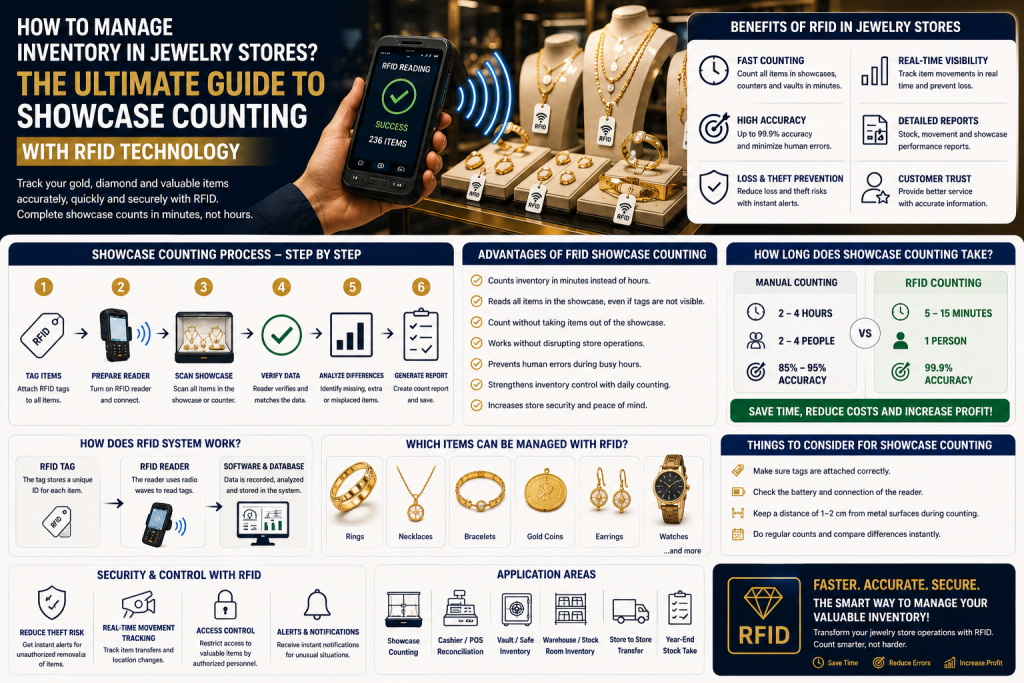
If you have not encountered RFID before, here is how it works: a small electronic label attached to each piece of jewellery receives energy from a reader device via radio waves and transmits its identity. The key difference from barcodes is this — barcodes must be scanned one by one; with RFID you pass the reader over the display case once and every piece is read simultaneously.
1
Each piece receives a small HF RFID label — once
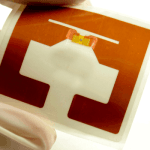
Integrated into the price tag or as an ultra-small sticker (as small as 8×8 mm). Invisible to customers, does not affect the appearance or value of the piece. Removed with the price tag at point of sale.
Integrated into the price tag or as an ultra-small sticker (as small as 8×8 mm). Invisible to customers, does not affect the appearance or value of the piece. Removed with the price tag at point of sale.
2
Pass the reader over the display glass
HF RFID signal passes through glass. You do not need to open the case. Hold the reader 10–15 cm from the glass and move it slowly across — 15–20 seconds per case, 5–10 minutes for 300 pieces total.
HF RFID signal passes through glass. You do not need to open the case. Hold the reader 10–15 cm from the glass and move it slowly across — 15–20 seconds per case, 5–10 minutes for 300 pieces total.
✓
The system reports instantly
Missing pieces, items in the wrong case and unrecorded items are flagged immediately. The report is generated automatically. No manual data entry required.
Missing pieces, items in the wrong case and unrecorded items are flagged immediately. The report is generated automatically. No manual data entry required.
Why HF RFID, not UHF? Gold, silver and platinum absorb and reflect UHF radio signals, causing unreliable reads. In jewellery applications, HF (13.56 MHz) must be used — it performs stably near precious metals. If you install a UHF system in a jewellery store, you will encounter read errors and inconsistent results that undermine confidence in the system.
6. Daily Jewellery Stock Routine That Actually Works
Whichever method you use, consistent daily discipline is what keeps stock records accurate. Here is the routine that works:
🌅 Opening Count (5–15 min)
Count the display before opening. With RFID: 5 minutes. With barcodes: a quick visual check. Identify any missing or misplaced items before customers arrive.
🛍 At Point of Sale (instant)
Process each item out of stock when sold. With RFID desk reader: automatic on placement. With barcodes: scan at the time of sale — never batch this for later.
🔄 When Moving Items (every time)
Record every transfer between cases or to/from the safe. RFID tracks this automatically. Barcodes require manual entry — every delay creates a discrepancy.
🌙 Closing Count (5–20 min)
End-of-day count. Compare physical stock against the system. If there is a discrepancy, find it that evening — next morning it is much harder to trace.
7. Cost Comparison
If RFID sounds expensive, you may be looking only at the upfront cost rather than the total cost of ownership. Here is the full picture:
| Cost Item | Barcode System | HF RFID System |
|---|---|---|
| Upfront hardware | £500–2,000 | £3,000–8,000 |
| Annual label cost | £100–400 | £500–1,500 |
| Staff counting hours (annual) | ~200 hours | ~20 hours |
| Average shrinkage rate | 1.5–3% | 0.2–0.5% |
| Annual net saving (£500k turnover) | Reference | +£8,000–15,000 |
On this basis, a jeweller with £500,000 annual turnover typically recovers the RFID investment within 8–18 months. Higher turnover or higher shrinkage rates shorten that payback period further.
Get a free stock analysis for your jewellery store
Share your piece count and current counting time — we will calculate which method suits you and what you stand to save.
Get Free Consultation → Jewellery RFID Labels8. Frequently Asked Questions
What is the best stock management system for a jewellery store?
Specialist jewellery retail software handles cataloguing, pricing and sales records well, but physical counting is still done by barcode or hand. The best overall system combines your existing jewellery software with an RFID layer for physical counting — dramatically improving speed and accuracy without replacing what already works.
How often should a jeweller count the display?
Ideally, opening and closing counts should happen daily. With barcodes this is impractical — it takes too long. With RFID, a daily count takes 5–10 minutes and becomes a normal part of the routine. At minimum: a full weekly count and a daily spot check of the highest-value cases.
From how many pieces does RFID make sense?
From around 150 pieces upwards, RFID typically pays back within 12–18 months. Between 50 and 150 pieces the benefit is real but the payback takes longer. Below 50 pieces, a barcode system is probably sufficient. Exception: if your pieces are high-value or you are experiencing frequent losses, RFID makes sense from 50 pieces.
Will the RFID label damage the jewellery or affect its value?
No. Jewellery RFID labels are produced in very small formats — as small as 8×8 mm — and are ultra thin. They are integrated into the price tag or applied to an inconspicuous surface of the piece. They do not affect the appearance or value of the jewellery. They are removed with the price tag at the point of sale.
Do I need to replace my existing jewellery software?
Almost certainly not. Most jewellery retail software either has an RFID module or can integrate with a standalone RFID counting application via API or periodic sync. Share the system you use and we will confirm compatibility before you commit to anything.
Can I run a pilot test before committing to the full system?
Absolutely — and we recommend it. Choose one display case or product category, label 50–100 pieces and run the system for 4–6 weeks. Once you see the results, the decision to roll out across the whole store becomes straightforward. RFID Depo provides free technical support for pilot projects.
Conclusion
Jewellery stock management is demanding, but it is not an unsolvable problem. The right method depends on your piece count, your shrinkage rate and how often you need to count.
If you are still counting by hand or barcode, you are spending hours every week, making errors and discovering losses far too late. With RFID, the same count takes ten times less, the store stays open, and losses are caught the same day they occur.
For the full step-by-step installation guide, read the companion article:
📖 RFID Stock Counting in Jewellery: Step-by-Step Guide →
Label selection, software setup, first count and daily integration — every step in one guide.
Related pages: RFID Jewellery Solutions · Jewellery RFID Labels · RFID Handheld Terminals · Why Is Stock Taking So Slow?