No products in the cart.
RFID Depo Editorial Team · August 2026 · 9 min read
The count is done. The report says 1,247 units. The shelf holds 1,189. 58 units missing. Where did they go? Who took them? When did they leave? These questions usually go unanswered. This scenario plays out in most warehouses at every stocktake. This guide explains why stock discrepancies occur and how to eliminate them permanently.
Warehouse stock discrepancy — the gap between what the system says you have and what is physically on the shelf — is one of the most widespread and costly problems in logistics and supply chain operations. Many warehouses accept it as "normal" and move on. But those gaps compound month after month into serious financial losses.
The good news: the vast majority of stock discrepancy is preventable. But prevention starts with correctly diagnosing the cause.
📋 Table of Contents
1. The Real Cost of Stock Discrepancy
Stock discrepancy is not just a "missing product" problem. It triggers a chain of financial and operational consequences:
💸 Direct Loss
The value of products recorded in the system but not physically present. Typically 2–5% of annual turnover in average warehouses.
❌ Wrong Orders
Stock showing as "available" in the system is actually not there — orders are delayed, customers cannot be fulfilled.
📦 Overstock
Stock showing as "out" is actually sitting in the warehouse — the same product gets reordered, tying up cash and space.
⏱ Count Cost
Staff time spent investigating discrepancies and the operational disruption of closing for a count. 200+ hours annually in larger warehouses.
The real calculation: A warehouse with £5 million annual turnover and a 3% shrinkage rate is losing £150,000 per year. Most of that is preventable. The right system brings it below 1% — saving over £100,000 annually.
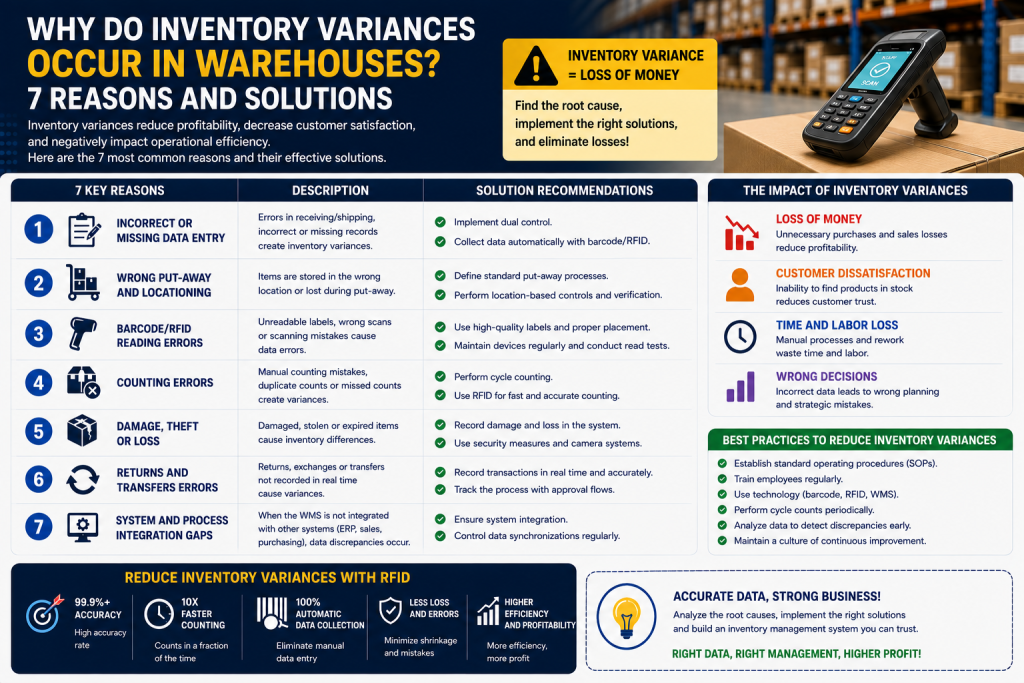
2. 7 Root Causes of Warehouse Stock Discrepancy
1
Manual Data Entry ErrorsWrong quantity entered at goods receipt. Different figure recorded at despatch. Quantity typed by hand rather than scanned. Each error seems small but they accumulate into large discrepancies over time.
📊 Responsible for approximately 30–40% of all stock discrepancies.
2
Unrecorded Stock MovementProducts moved within the warehouse without being recorded in the system. Items transferred between bays left off the record. Returns not booked back into stock. Samples or display items taken without a system entry.
📊 Particularly common in large, multi-level warehouses with high movement volumes.
3
Inaccurate or Incomplete CountingItems missed during barcode scanning — dark corners, high shelves, back-of-rack products. Poor coordination between count teams — some items counted twice, others not at all. Fatigue and lost concentration as the count drags on.
📊 Error rates in long manual counts rise from around 1% in the morning to 5% by the afternoon.
4
Damage, Spoilage and Write-offsProducts damaged in the warehouse, expired or rendered unusable are not removed from the system promptly. Months later they appear as "missing" at the next count — but they were simply never written off properly.
📊 Most significant in food, pharmaceutical and chemical warehouses.
5
Theft and Unauthorised UseInternal theft, external theft, or staff helping themselves to products informally without recording the movement. Without a real-time tracking system, these losses go undetected until they accumulate into a significant discrepancy.
📊 Accounts for 15–25% of total warehouse shrinkage across most sectors.
6
Supplier ShortagesOrder placed for 100 units, 97 delivered — but goods receipt is processed as 100 without a physical count. The supplier's invoice is accepted unchecked and the shortage is absorbed into the warehouse's discrepancy. Particularly common during busy receiving periods.
📊 Can account for up to 10% of annual discrepancy in warehouses without strict goods receipt procedures.
7
System Integration ErrorsSynchronisation failures between WMS, ERP and warehouse software. An update made in one system not reflected in another. The same product recorded under different codes in two systems. A row skipped during a manual data export.
📊 An increasingly common cause as operations run multiple software platforms simultaneously.
3. Which Cause Applies to Your Warehouse?
Every warehouse has a different discrepancy profile. Use this table to identify where your problem is most likely coming from:
| Symptom | Likely Cause |
|---|---|
| Discrepancy is similar in size at every count | Cause 1 — Ongoing data entry errors |
| Discrepancy concentrated in specific product categories | Cause 5 — Theft or unauthorised use |
| Discrepancy reappears quickly after a count | Cause 2 — Unrecorded stock movement |
| Discrepancy rises during peak season or shift changes | Cause 3 — Count errors, coordination issues |
| Discrepancy increases with a new supplier or product line | Cause 6 — Supplier shortages at goods receipt |
| Discrepancy grew after a software migration | Cause 7 — System integration error |
4. Permanent Solutions
Reducing stock discrepancy permanently requires a layered approach — not a single fix:
✅
Tighten Goods Receipt Procedures
No products should be entered into the system until a physical count has been completed. The supplier delivery note must be checked against the physical goods and signed off. Any shortage must be reported to the supplier immediately and not silently absorbed.
No products should be entered into the system until a physical count has been completed. The supplier delivery note must be checked against the physical goods and signed off. Any shortage must be reported to the supplier immediately and not silently absorbed.
✅
Record Every Stock Movement Immediately
Internal transfers, returns, samples and write-offs must be recorded in the system at the time they happen. The "I'll enter it later" habit is one of the biggest contributors to stock discrepancy. Make it a rule: if it moves, it gets recorded.
Internal transfers, returns, samples and write-offs must be recorded in the system at the time they happen. The "I'll enter it later" habit is one of the biggest contributors to stock discrepancy. Make it a rule: if it moves, it gets recorded.
✅
Count More Frequently
Replace the annual full count with monthly or cycle counting. A discrepancy caught when it is small is far easier and cheaper to investigate than one discovered twelve months later. Cycle counting counts a different section each week so the entire stock is covered across the year.
Replace the annual full count with monthly or cycle counting. A discrepancy caught when it is small is far easier and cheaper to investigate than one discovered twelve months later. Cycle counting counts a different section each week so the entire stock is covered across the year.
✅
Implement Access Controls
Define clearly who can access which areas and which products. RFID access control systems prevent unauthorised entry. High-value products should be stored in a secured area with restricted access.
Define clearly who can access which areas and which products. RFID access control systems prevent unauthorised entry. High-value products should be stored in a secured area with restricted access.
✅
Audit System Integrations
Regularly check data flows between WMS, ERP and accounting software. A daily automated reconciliation report flags system-level discrepancies the same day they occur, before they accumulate.
Regularly check data flows between WMS, ERP and accounting software. A daily automated reconciliation report flags system-level discrepancies the same day they occur, before they accumulate.
5. Modern Fix: Eliminating Discrepancy with RFID
The procedural changes above will reduce discrepancy — but they will not eliminate it, because the root cause is almost always human error, and human error never disappears completely. The permanent fix is a system that takes human error out of the equation.
This is where RFID comes in. A small electronic label on each product means:
📡 Goods Receipt
Incoming products are counted automatically in seconds via an RFID portal or handheld. Compared against the supplier delivery note instantly. Any shortage triggers an immediate alert.
🔄 Internal Movement
When a product moves from one location to another, the RFID system records it automatically. No staff data entry required — the record is always up to date.
📦 Despatch
The RFID portal at the outbound gate records every item leaving. Wrong or incomplete shipments are flagged before the truck door closes.
📊 Rapid Counting
Staff walk the aisles with an RFID handheld and every product is read automatically. 1,000 products in 20–40 minutes — the same count takes 4–8 hours with barcodes.
| Metric | Barcode / Manual | RFID |
|---|---|---|
| Inventory accuracy | 94–97% | 99%+ |
| Annual shrinkage rate | 2–5% | 0.3–1% |
| Practical count frequency | Monthly / quarterly | Weekly or daily |
| Goods receipt time (1,000 lines) | 2–4 hours | 15–30 minutes |
| Time to detect a discrepancy | At the next count | Same day / real time |
Why does RFID reduce discrepancy so dramatically? Because it removes human error from the process. Goods receipt, internal movement and despatch are all recorded automatically. There is no opportunity for staff to "forget" to scan something or enter the wrong figure. The stock record reflects reality at all times.
Want to analyse the stock discrepancy in your warehouse?
Share your warehouse size, product count and current shrinkage rate — we will calculate what RFID could save you and build a solution around your operation.
Get Free Consultation → RFID Warehouse Solutions6. Frequently Asked Questions
What is an acceptable warehouse stock discrepancy rate?
It varies by sector. In general warehousing and logistics, below 1% is considered good; above 2% is a red flag. In retail, 2–5% is common but should not be accepted as normal. Warehouses using RFID bring this down to 0.3–1%. Zero is not realistic, but below 1% is an achievable target.
How often should warehouse stock be counted?
An annual full count is not sufficient. Cycle counting — counting a different section each week so the entire warehouse is covered over the year — is the industry standard. With RFID, counting is so fast that weekly or daily checks become practical routine rather than a major operational event.
Does RFID installation disrupt warehouse operations?
No. RFID labelling and system setup take place while the warehouse continues to operate. Products are labelled as they are received or while they are on the shelf. A full transition typically takes 2–6 weeks and the warehouse never needs to close.
What is the most common cause of warehouse stock discrepancy?
Manual data entry errors account for 30–40% of all discrepancies. Unrecorded internal stock movement and counting errors are the other two most significant contributors. In most warehouses, all three are present simultaneously.
Will RFID integrate with our existing WMS or ERP?
Yes. RFID systems integrate with SAP, Oracle, Microsoft Dynamics and most major WMS platforms. Share which system you use and we will confirm compatibility and map out the integration approach before you commit to anything.
Conclusion
Warehouse stock discrepancy is not inevitable. Every discrepancy has a cause, and every cause has a solution. The key is making the right diagnosis and responding with proportionate action.
Tightening procedures is a good starting point. But for measurable, lasting results, technology needs to be part of the answer. RFID brings inventory accuracy above 99%, cuts shrinkage dramatically, and catches discrepancies the same day they occur — before they compound into significant losses.
Related content: Why Is Stock Taking So Slow? · Barcode vs RFID: Which Is Right for Your Warehouse? · RFID Warehouse Management System · RFID Handheld Terminals · Warehouse RFID Tags