No products in the cart.
RFID Depo Editorial Team · July 2026 · 8 min read
A typical retail clothing store's annual stocktake takes 2–3 days. For a mid-sized e-commerce warehouse, that can stretch to a full week. During that time, the store is either closed or operating at reduced capacity, staff are exhausted, and the results still aren't 100% accurate. Why does this keep happening? And more importantly — is there a way to actually fix it?
We have yet to meet a business owner who enjoys stocktaking. For most, it is a necessary evil — a process that drains staff, halts operations and, when it is finally over, leaves everyone unsure whether the numbers are even right.
In this article we explain why stocktaking is so slow, which costs go unnoticed, and how RFID technology completes the same count up to 10 times faster.
📋 Table of Contents
1. Why Is Stocktaking So Slow?
The answer is simple: because it is done one item at a time.
In traditional stocktaking, every product is either counted by hand and written down, or scanned one by one with a barcode reader. In a warehouse holding 1,000 items, that means 1,000 separate operations. Even if each scan takes just 3–5 seconds, that only covers the scanning itself — finding the item, positioning the reader correctly and recording the data takes considerably longer.
Then add the following:
⚠
Products are scattered and hard to reach
Items at the back of a shelf, boxes stacked high, tangled packaging — barcode readers require a clear line of sight to every single one.
Items at the back of a shelf, boxes stacked high, tangled packaging — barcode readers require a clear line of sight to every single one.
⚠
Human error is inevitable
Staff performing the same repetitive task for hours become tired and lose focus. Items get counted twice or missed entirely.
Staff performing the same repetitive task for hours become tired and lose focus. Items get counted twice or missed entirely.
⚠
Operations halt or slow down
Warehouse intake is restricted, stores are closed, or sales floors are left in disarray. Normal operations suffer.
Warehouse intake is restricted, stores are closed, or sales floors are left in disarray. Normal operations suffer.
⚠
Data entry is a second workload
Numbers written on paper or entered into a handheld must be transferred to the system, cross-checked, and discrepancies resolved through recount.
Numbers written on paper or entered into a handheld must be transferred to the system, cross-checked, and discrepancies resolved through recount.
2–5 days
Annual count time for a mid-sized warehouse
3–5%
Average error rate in manual stocktaking
8–12%
Stock shrinkage rate in apparel retail
2. Seven Hidden Costs — The Invisible Ones Hit Hardest
The true cost of stocktaking is not simply "hours spent multiplied by staff wages." There are far heavier costs that go unnoticed:
1
Lost revenue from closed operations
Sales foregone while the store is shut or the warehouse is restricted. For larger retailers, this can reach significant sums per day.
Sales foregone while the store is shut or the warehouse is restricted. For larger retailers, this can reach significant sums per day.
2
Overtime pay
Stocktakes are typically carried out at night or over the weekend. Overtime wages directly impact the budget.
Stocktakes are typically carried out at night or over the weekend. Overtime wages directly impact the budget.
3
Ordering errors
Procurement decisions based on inaccurate counts — reordering stock that already exists, or failing to spot a line that has actually run out.
Procurement decisions based on inaccurate counts — reordering stock that already exists, or failing to spot a line that has actually run out.
4
Discrepancy resolution
When count results do not match the system, recounts are carried out, managers are pulled in, and reports are written up. This process sometimes takes as long as the original count.
When count results do not match the system, recounts are carried out, managers are pulled in, and reports are written up. This process sometimes takes as long as the original count.
5
Staff productivity loss
In the days before and after a stocktake, staff work tired and demotivated. General productivity across the business falls.
In the days before and after a stocktake, staff work tired and demotivated. General productivity across the business falls.
6
Shrinkage blindness from infrequent counting
Because stocktaking is expensive and disruptive, it is done only once or twice a year. Losses, theft and damage that occur in between are detected far too late.
Because stocktaking is expensive and disruptive, it is done only once or twice a year. Losses, theft and damage that occur in between are detected far too late.
7
Customer satisfaction loss
Inaccurate stock data means a product showing as "in stock" is actually unavailable. Orders cannot be fulfilled, returns increase and customers are lost.
Inaccurate stock data means a product showing as "in stock" is actually unavailable. Orders cannot be fulfilled, returns increase and customers are lost.
3. Why Barcode Systems Are Not Enough
If you are thinking "we already use a barcode system and scan with a handheld" — that describes the majority of businesses reading this article. A barcode system is better than nothing, but it has one fundamental limitation: every item still has to be scanned individually.
| Barcode Handheld | RFID Handheld |
|---|---|
| Barcode must be visible | Label does not need to be visible |
| One item at a time, sequentially | Dozens of items read simultaneously |
| 3–10 seconds per item | 100 items in approximately 10 seconds |
| Damaged barcode = unreadable | Damaged label — chip still reads |
| Cabinets and boxes must be opened | Reads through closed packaging |
| 1,000 items ≈ 1–2 hours | 1,000 items ≈ 5–10 minutes |
💡 The critical difference: A barcode system does not make stocktaking faster — it is simply more reliable than pen and paper. RFID changes the underlying logic entirely. Instead of scanning items one by one, you walk into a zone and wave the device around. The system finds everything on its own.
4. How RFID Stock Counting Works
A small RFID label is applied to each product. The label contains a unique identification number (EPC). When a member of staff walks through the warehouse or stockroom carrying an RFID handheld terminal, the device reads all tags within 1–5 metres simultaneously.
1
Each product receives an RFID label — once
A small electronic label applied to a garment tag in a clothing store, or to product packaging or a carton in a warehouse. Once applied, it stays with the product for its lifetime.
A small electronic label applied to a garment tag in a clothing store, or to product packaging or a carton in a warehouse. Once applied, it stays with the product for its lifetime.
2
Staff walk the area with the RFID handheld
The handheld reads all nearby tags within seconds. Staff simply hold the device and walk slowly — nothing else is required. No touching individual items, no opening shelving units, no rotating boxes.
The handheld reads all nearby tags within seconds. Staff simply hold the device and walk slowly — nothing else is required. No touching individual items, no opening shelving units, no rotating boxes.
3
The system compares in real time
The EPC numbers read are matched against the stock record in the system. Missing items, surplus items and items in the wrong location are flagged instantly. The report is generated automatically.
The EPC numbers read are matched against the stock record in the system. Missing items, surplus items and items in the wrong location are flagged instantly. The report is generated automatically.
✓
Count complete
Data uploaded, report ready. Error rate below one percent. Time taken: 10–30 minutes depending on zone size. Operations can resume immediately.
Data uploaded, report ready. Error rate below one percent. Time taken: 10–30 minutes depending on zone size. Operations can resume immediately.
5. Manual vs RFID: Real Numbers
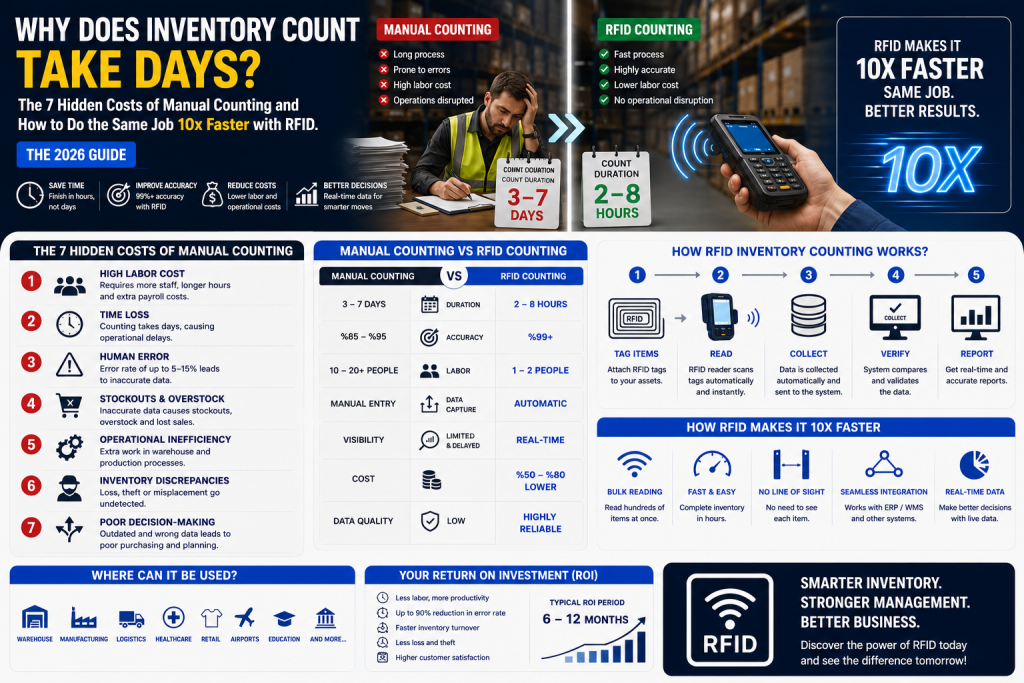
| Scenario | Manual / Barcode | RFID |
|---|---|---|
| 500-item retail floor | 45–90 minutes | 4–8 minutes |
| 5,000-item apparel warehouse | 8–16 hours (1–2 days) | 45–90 minutes |
| 20,000-item e-commerce warehouse | 3–5 days | 4–8 hours |
| Count accuracy | 95–97% | 99%+ |
| Operational downtime | Full or partial closure | Operations can continue |
| Count frequency | Once or twice a year (too costly) | Weekly or even daily — practical |
What changes when counting becomes this fast? Instead of one gruelling annual stocktake, you can run quick checks weekly or even daily. Losses and discrepancies are caught far earlier. You replace the end-of-year big count with continuously accurate stock data.
6. Gains by Sector
👕 Clothing and Apparel Retail
An end-of-day floor count that takes 45–90 minutes with barcodes drops to 5–10 minutes with RFID. Staff redirect that time to serving customers. Rather than a handful of major counts per year, a quick daily check becomes practical — minor discrepancies are caught before they become serious problems.
📦 E-Commerce and Logistics Warehouses
The 2–3 annual counts that freeze operations for days become monthly or weekly rapid checks. Dispatch errors fall, return costs drop, and customer satisfaction improves.
💎 Jewellery
Counting hundreds of small items across display cases can take hours. HF RFID-tagged jewellery counts in minutes. Opening and closing display checks become automated, dramatically reducing theft risk.
🏭 Manufacturing
Raw material and WIP (work in progress) tracking becomes real time. Count verification along the production line is automated. Year-end fixed asset and stock audits are completed with minimal manual effort.
7. How Long Does It Take to Switch to RFID?
The transition sounds complex, but setting up an RFID stock counting system is far more straightforward than most people expect. The basic steps are:
Week 1
Select the right RFID label for each product type, run samples
Weeks 2–3
Bulk labelling, link tags to stock records in the system
Weeks 3–4
Handheld terminal setup, staff training
Week 4+
First RFID count — see the results
For small and medium-sized businesses, this transition is typically complete within 3–4 weeks. Labelling is the most time-consuming step, but done in bulk it moves considerably faster than expected.
Want to speed up your stocktaking?
Share your product type, stock volume and current count time — we will calculate exactly what you stand to gain with RFID. Consultation is free.
Get Free Consultation → RFID Handheld Terminals8. Frequently Asked Questions
Will RFID integrate with my existing stock management system?
Yes. RFID handhelds connect to your existing stock software, ERP or WMS via Wi-Fi. Integration is possible with SAP, Oracle, Microsoft Dynamics and most custom systems. Share the system you use and we will confirm compatibility.
Doesn't labelling every product take a very long time?
Bulk labelling is faster than most people expect. Tagging 1,000 products takes roughly 2–4 hours of staff time. In the apparel sector, many suppliers now ship products pre-tagged with RFID labels — in that case, no additional labelling is required at the store.
How many products do I need before RFID makes sense?
As a general rule, if you hold more than 500 SKUs and count at least once a month, an RFID investment typically pays for itself within 12 months. Between 200 and 500 items, the benefits are still real but the payback period is a little longer.
Does the store or warehouse have to close during an RFID count?
No — this is one of RFID's greatest advantages. An RFID count can be carried out while operations are running. Staff walk the floor with the handheld terminal while customers continue shopping and deliveries continue arriving.
How long do RFID labels last?
Lifespan varies with the application. Standard indoor labels last 5–7 years. Washable textile labels withstand 50+ washes. Industrial on-metal tags last 7–10 years. The label's environment and the surface it is applied to are the main determining factors.
Conclusion
Stocktaking is slow not because of a lack of technology, but because of the wrong technology. Barcode and manual counting are built on a one-at-a-time logic — they are labour-intensive, error-prone and disruptive to operations.
RFID reverses that logic entirely. You no longer scan items individually — the system finds them all at once. A count of 1,000 items drops from hours to minutes. The error rate falls below one percent. And most importantly, you no longer dread stocktaking — because with RFID, you can do it every week if you want.
Related pages: RFID Handheld Terminals · UHF RFID Tags · RFID Warehouse Management · Fixed Asset Tracking Guide